


Bee Mindful: Yoga as an Intervention for Social Emotional Learning in Schools
The purpose of this project was to address SEL by utilizing yoga as an intervention to increase academic participation within a Tier 1 school system. I utilized the SSIS assessment: teacher report as a pre- and post- quasi- experimental study.
 |  |  |  |
|---|

Yoga
Weeks 1-2: Intro to Yoga
I began initially with introduction to the benefits of yoga: connecting our breath, mind, and body; helping us focus; moving our bodies. Many students had the ability to practice some yoga in their classrooms already, but others were not familiar with yoga. It was important for me to take into account each class's cognitive, physical, and motivational abilities when deciding on yoga poses and practices. For example, one class benefitted greatly from videos and stories to lead them in yoga, while others played games and were able to follow my demonstration. Week 1 was dedicated to understanding how these classes learned and any modifications that needed to be made based on physical abilities. One student was diagnoses with osteogenesis imperfecta and was wheelchair bound. Another student had a diagnosis of arthrogryposis with limited UE mobility and strength. These students were still able to participate in a Tier 1 system with modifications offered for all students.

Emotions
Weeks 2-5: Emotions
These weeks consisted of introducing ways to teach about various emotions: anger, sadness, excitement and how to identify each emotion not only in themselves, but in their friends. We read stories, heard scenarios, and practiced identifying each emotion as well as tools to use when we feel angry.

Real-Life
Weeks 5-8: Combine
Final weeks were designed to combine emotional tools and yoga poses in a variety of games, real-world situations, and classroom observation. The yoga demonstrations from teacher were slowly faded out in order to determine individual understanding and greater leadership from students.
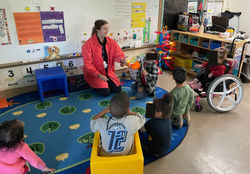
"Classroom yoga". Retrieved from Lauren Frank [photo]
Data Collection


*See below for interpretation of results
Yoga Intervention Classrooms
Control Classroom

= Statistical significance (95% confidence)
Yoga Intervention Classrooms
Control Classroom

Based on the results of the SSIS assessment with both yoga intervention classrooms and control classrooms, it shows that all four control classrooms demonstrated an increase in social skills and a decrease in problem behaviors when compared to the control classrooms. The control classrooms who did not receive the yoga program demonstrated either an increase in problem behaviors or decrease in social skills when compared to the classrooms who received the intervention.
Tools Used During Classroom Yoga
Based on learning styles of each classroom, I used a variety of tools and techniques in order to teach yoga and emotions such as books, videos, visual cards, and games.

Books

Spelman, C. M. (2000). When I Feel Angry. Albert Whitman & Company.


Brown, M. W. (2016). Goodnight Moon. HarperCollins.
Martin, B., Jr. (1996). Brown Bear, Brown Bear, What Do You See?: 25th Anniversary Edition. Macmillan.
Case Study*
Student is a 5 year, 5 month currently in Head Start (Pre-K) program in Rock Island, IL. Student has a past medical history of speech/language delay, premature (31 weeks) birth, torticollis, and cord wrap upon birth. Doctors recommend further testing to rule out ASD, but parents are not pursuing. He has a twin brother with similar difficulties. Student currently experiences difficulties with sensory integration and processing, visual motor integration, core stability, and participation in some academic activities. He participates in occupational therapy, speech therapy, and special education services in order to address academic participation deficits.
One special education goal is to participate and transition after recess time and sit at circle time with no adverse behaviors. Student often demonstrates elopement, crying, yelling, and refusal to participate as circle time is non-preferred.
When yoga intervention was implemented, student would be excited to transition for “yoga time” at the carpet, where circle time is held. He would audibly and physically be excited to sit and participate. He required no cueing to sit and participate. When yoga cards were presented or teacher did yoga demonstration, student would independently attempt the pose and smile when given praise. When given verbal cues to do deep breathing or “dragon breath”, student would demonstrate independently, showing cognitive retention and understanding of the task at hand through imitation and his ability to demonstrate various poses.
After circle time, he would easily transition to next activity and remain regulated throughout. He also participated in sharing activities with friends and would often respond and allow friends to participate in his preferred activities, a major improvement from before yoga intervention.
*Case Study published with verbal permission from student's parent. No identifying factors utilized for student's privacy.